

Yes, you can insulate a conservatory roof yourself DIY in some cases, but it depends on the roof, the materials, your skill level, and the finish you expect. A quick DIY fix may help with glare or mild heat loss. A full roof upgrade is a different job altogether. If your conservatory is too hot in summer, too cold in winter, noisy in the rain, draughty, or barely used, it is worth comparing DIY conservatory roof insulation with a fitted insulated roof system before you spend money.
In this article, we explore what DIY conservatory roof insulation can and cannot do, where the real risks sit, what costs to think about, and when a local fitted solution may be the better long-term choice.
Can you insulate a conservatory roof yourself DIY?
The honest answer is yes, but not every conservatory roof is a good DIY job.
A homeowner can usually fit thermal blinds, solar film, or a basic DIY conservatory roof insulation kit with the right tools and patience. Those options can make the room feel a little more controlled, especially if the main problem is bright sun or glare. The trouble starts when the job involves large roof panels, awkward sloped sections, leaks, condensation, old seals, fixed roof fittings, or a finish that needs to look clean from inside the room.
Here’s the thing. A conservatory roof is not like a standard indoor ceiling. It often has glass or polycarbonate panels, roof bars, seals, fixings, trims, and drainage paths. If one part is poorly sealed, the room may still feel cold, damp, or noisy. Worse, a cheap fix can trap moisture and leave the space looking worse than before.
For small comfort gains, DIY might work. For a proper year-round room, ComfiSpace’s fitted ComfiBoard roof upgrade is usually the cleaner route because it is designed to improve comfort without turning the job into a drawn-out replacement project.
Why conservatory roof insulation matters in the first place
Most conservatories were not built to feel like normal living rooms. They were often designed to bring in light, not to hold a steady temperature. That is why many homeowners end up with a room that is lovely for a few weeks of the year and frustrating for the rest.
In summer, sunlight hits the roof, and the room heats up fast. In winter, warmth escapes through the roof and glazing. Rain can sound louder than expected. Condensation can appear when warm indoor air meets cold roof surfaces. Before long, the conservatory becomes the place for spare furniture, laundry, or things that do not fit anywhere else.
With a conservatory, the roof is usually where the biggest comfort problem is felt. ComfiSpace’s working view, based on more than 1,000 conservatory upgrades, is that the roof can account for the vast majority of heat and comfort loss in a typical conservatory. Once the roof is properly insulated, homeowners commonly notice the room feels more comfortable from day one, with less heat build-up in summer and less cold in winter.
There is no single official UK measurement that applies to every conservatory, because conservatories vary so much in size, age, glazing, roof shape, and construction. That is why ComfiSpace focuses on practical results from real homes: a room that feels easier to use, without the cost and hassle of a full roof replacement in most cases.
In ComfiSpace’s experience, most conservatory comfort loss is felt through the roof, and a properly fitted ComfiBoard upgrade can deal with the biggest part of that problem without pushing the homeowner towards a larger replacement job.
If you are not sure why the room feels so hard to use, ComfiSpace covers why conservatories get too warm and too cold in a way that breaks down the comfort issue in simple, practical terms, making it easier to understand where the problem starts.
DIY conservatory roof insulation options homeowners usually consider
There is no single DIY method that suits every conservatory. A lean-to with a simple polycarbonate roof is not the same as a larger Edwardian or Victorian conservatory with awkward angles. Some jobs are more about shade. Others are about heat loss, rain noise, draughts, or old panels.
| DIY option | Best suited to | What to watch before you buy |
| Thermal roof blinds | Rooms that need shade, glare control, or a softer look | They help with comfort, but they are not the same as a true insulated conservatory roof |
| Solar control film | Glass roofs that overheat in direct sun | It may reduce glare and solar gain, but it will not fix leaks, draughts, or winter heat loss on its own |
| Multifoil insulation kit | Skilled DIYers who want a lower-cost internal layer | The finish depends on careful fitting, sealing, and trim work |
| Internal boards or cladding | Homeowners who want a more solid ceiling appearance | Weight, ventilation, moisture control, and fixings need careful thought |
| DIY insulated conservatory roof panels | Roofs where old panels can be replaced like-for-like | Measuring, panel choice, roof pitch, seals, and weatherproofing all matter |
| ComfiBoard fitted roof upgrade | Homeowners who want a warmer, cooler, quieter room without a full tiled/timber roof replacement | A home visit is needed so the existing roof can be checked and the right fit can be confirmed |
A DIY conservatory roof insulation kit can look tempting because it seems cheaper than a fitted system. That may be true at the checkout. But the checkout price is not the full story. You still need the right fixings, trim, access equipment, sealants, tools, disposal, and enough time to deal with mistakes.
That is why searches such as “conservatory roof insulation cost” or “cheap DIY conservatory roof panels” can be misleading. A low material price does not always mean a low finished cost.
A fitted ComfiBoard system is different because the homeowner is not trying to piece together a result from separate DIY materials. The roof is assessed, the panels are fitted as a system, and the aim is to make the conservatory usable again with the least possible hassle.
What can go wrong with DIY conservatory roof insulation?
The biggest DIY problem is not always danger. Sometimes it is disappointment. A homeowner fits insulation, spends a weekend on the roof, and still finds the room cold at night, hot in July, or damp after rain. That usually happens because conservatory insulation is not only about adding material. It is about how the whole roof handles heat, air, moisture, light, and water.
Poorly fitted insulation can leave gaps where warm air escapes. Heavy internal boards may not suit the existing roof. Badly sealed joints can let rain in. A dark internal finish can make the space feel smaller. If the roof already has leaks or condensation, insulation may hide the symptom rather than fix the cause.
The wrong DIY job can become a false economy. It may look cheaper at first, but if it does not solve the temperature problem, leaves a messy finish, or needs rework, the saving quickly starts to disappear.
This does not mean every DIY job is a problem. It means the method has to match the room. A small shade issue is one thing. A conservatory that is too hot, too cold, noisy, and unused is another.
DIY vs professional conservatory roof insulation cost
Conservatory roof insulation cost depends on the size, roof style, material, finish, access, and condition of the existing structure. A small lean-to will usually be simpler than a large roof with multiple hips and angles. A tidy roof with sound seals is easier than one that already leaks.
| Route | Typical upfront cost level | Best fit | Main risk |
| Film or blinds | Low | Homeowners who want less glare or a mild comfort boost | Limited winter benefit |
| DIY conservatory roof insulation kit | Low to medium | Confident DIYers with a simple roof and realistic expectations | Gaps, poor finish, or trapped moisture |
| DIY conservatory roof panels | Medium | Like-for-like panel replacement on a suitable roof | Leaks, wrong sizing, and difficult access |
| ComfiBoard fitted conservatory roof upgrade | Mid-range compared with full replacement | Homeowners who want a neater, warmer, cooler room with less disruption | Needs a home visit for accurate pricing |
| Full timber or tiled conservatory roof replacement | High | Homeowners who mainly want a different roof appearance or need a larger replacement route | A realistic starting point is not less than £12,000 plus VAT (£14,400), often with more disruption than a panel upgrade |
If the goal is just to reduce glare, a cheaper fix may be fine. If the goal is to make the room warmer in winter, cooler in summer, quieter in rain, and more usable as living space, the value is different. The question is not only “what does conservatory insulation cost?” It is “will this actually solve the problem?”
This is where ComfiBoard creates the clearest value gap. For many suitable conservatories, it can deliver the same insulation result a homeowner wants from a more expensive plastered/tiled roof route, but without the same cost, appearance-led rebuild, or disruption. In simple terms, the homeowner gets the comfort benefit without paying for more roof than they need.
Not sure whether DIY will go far enough? ComfiSpace offers a local, no-pressure home visit so you can understand the roof, the likely fix, and the real cost before you buy materials that may not solve the problem. You can see the step-by-step process here: how the ComfiSpace roof upgrade works.
Before you try DIY, check these first
A little planning can save a lot of grief. Before you buy a DIY conservatory roof insulation kit, check the roof as a whole rather than just the price of the materials.
| What to check | Why it matters | DIY risk level |
| Roof condition | Old panels, cracked seals, or small leaks can ruin the result | High |
| Safe access | Roof work needs stable access and care around fragile panels | High |
| Condensation marks | Insulation can trap moisture if the cause is not fixed | Medium to high |
| Fans, vents, or fixed fittings | Anything already fitted into or around the roof can make the job more complex | Medium to high |
| Roof shape | Sloped sections, hips, and awkward angles need precise fitting | Medium |
| Desired finish | A room used daily needs a cleaner finish than a storage space | Medium |
| Existing draughts | Roof insulation alone may not fix poor seals or gaps elsewhere | Medium |
A roof can look simple from the floor and still be awkward once you start. If there are signs of damp, movement, leaks, or poor seals, get advice first.
ComfiSpace’s fitted route is designed for homeowners who do not want to gamble with measurements, materials, access, and finish. The aim is straightforward: check the roof, explain the option clearly, and complete the upgrade with minimal disruption where the conservatory is suitable.
When DIY might be enough
DIY can be enough when the problem is small, and the roof is in good condition.
If the conservatory only gets too bright at certain times of day, roof blinds or film may help. If the roof has no leaks, no signs of damp, no fixed roof fittings in the way, and no awkward shape, a careful homeowner may be able to fit a light internal insulation product. If you enjoy DIY, have safe access, and do not expect a showroom-level finish, this might work for you.
DIY also makes more sense when the conservatory is not meant to become a main living space. For example, if it is used as a plant room, hobby space, or occasional sitting area, a modest upgrade may be enough. A fitted conservatory roof upgrade may be more than you need.
Still, it helps to be honest before you start. If you would be annoyed by visible joins, uneven boards, less overhead daylight, or a weekend job that turns into three weekends, DIY may not feel cheap for long.
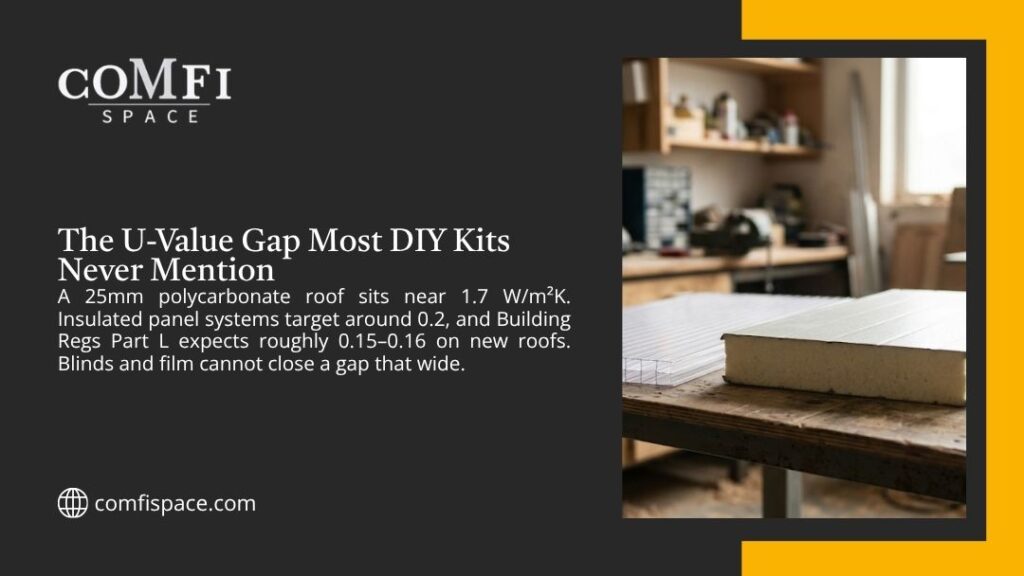
When a DIY conservatory roof insulation kit is probably a false economy
A DIY kit is less attractive when the conservatory already has signs of bigger trouble.
Leaks, draughts, cracked panels, loose seals, condensation marks, stained trims, or a roof that moves in bad weather all point to problems that insulation alone may not fix. If the room is unbearable in summer and freezing in winter, a thin internal layer may take the edge off, but it may not create the year-round comfort you want.
Roof shape matters too. Slanted roofs, hips, valleys, awkward bars, and larger spans take more skill than a flat internal board job. Many homeowners ask, “What is the best way to install insulation on a slanted roof?” The simple answer is that the insulation must follow the roof correctly, stay secure, allow the right moisture control, and leave a neat finish. That is a lot to ask from a cheap kit if the roof is complex.
A DIY conservatory roof insulation kit can also become a false economy when the room needs to look part of the home. If you plan to use the conservatory as a dining room, home office, playroom, gym, or second lounge, the finish matters. A room can be warmer and still feel unfinished.
ComfiSpace focuses on one main job: helping local homeowners turn unused conservatories into rooms they can use again. The fitted ComfiBoard route is made for homeowners who want the comfort result without trial and error, patchwork materials, or a finish that looks like a compromise.
Why ComfiBoard Is Often the Cleaner Fix
ComfiBoard should not be lumped in with basic under-ceiling boards or generic interior panel insulation. It is ComfiSpace’s fitted insulated roof panel system, designed to upgrade an existing conservatory roof without pushing the homeowner into a full timber or tiled replacement where that is not needed.
That difference matters. DIY insulation often tries to work around the existing roof from the inside. ComfiBoard is fitted as part of a more complete roof upgrade, giving the conservatory a cleaner finish and a more reliable comfort improvement.
A full tiled or timber roof replacement may change the look of the roof, but that does not automatically mean it gives a better insulation result than ComfiBoard. For many homeowners, the real difference is appearance, disruption, and cost. ComfiBoard is designed to deliver the comfort benefit at a fraction of the price of a larger roof replacement route.
This approach can help with the problems that usually bother homeowners most. The room can feel less harsh in summer, less cold in winter, and less noisy in heavy rain. It can also look more like a proper room, which matters if the conservatory is attached to the kitchen, dining area, or living space.
For homeowners who want to understand the material side without heavy jargon, ComfiSpace explains what COMFIBOARD is and how it supports their roof upgrade system.
Can you insulate the underside of a conservatory roof?
Yes, you can insulate the underside of a conservatory roof, but it is one of those jobs that sounds simpler than it is.
The underside method usually involves fitting insulation below the existing roof and then covering it with a finish such as cladding or boards. Done well, it can make the room feel more enclosed and reduce some heat movement. Done badly, it can trap moisture, create condensation, look uneven, or interfere with how the roof performs.
Insulation has to sit in the right place. It needs secure support. Joints need care. The room must still deal with moisture. If condensation is already a problem, covering the underside of the roof without understanding why it happens may only hide the issue for a while.
Before you spend money on internal conservatory roof insulation cost, it’s worth understanding the truth about conservatory condensation. It highlights why moisture forms and why improving comfort often requires more than a quick fix.
Will DIY insulation make the conservatory darker?
Most internal conservatory roof insulation will reduce some overhead light. There is no way around that. If you cover glass or polycarbonate, less light comes through the roof.
That is not always a bad thing. Many conservatories are too bright to use on sunny days. Less glare can make it easier to watch television, work at a desk, read, or eat without squinting. A bright internal finish can also keep the room feeling fresh rather than boxed in.
The real question is balance. A homeowner might want roof insulation for conservatory comfort but still want the space to feel open. That balance depends on roof style, wall glazing, colour choice, and how the room is used. A good installer should explain what the room may feel like after the work, rather than just promise that everything will be better.
For visual reassurance, it can help to see real conservatory upgrades before deciding between DIY and a professional finish.
Is roof insulation worth it for a conservatory?
Roof insulation can be worth it when the current conservatory is wasted space. If a room cannot be used for much of the year, any money already spent on that conservatory is not doing its job.
Still, the right answer depends on the fix. A low-cost DIY method may be worth it for a small comfort issue. A fitted insulated roof for conservatory comfort may be worth it when the homeowner wants a room that feels more useful day to day.
| Question | DIY answer | ComfiBoard fitted upgrade answer |
| Will it reduce glare? | Often, yes, especially with film or blinds | Yes, as part of a more complete roof comfort upgrade |
| Will it help winter comfort? | Sometimes, but results vary by method and roof condition | Designed to make the room warmer in winter and easier to use |
| Will it reduce rain noise? | Limited to moderate, depending on materials | More likely to create a clear comfort improvement |
| Will it look aesthetically pleasing? | Only if the DIY finish is neat | Designed for a cleaner, more consistent finish |
| Will it support long-term use? | It depends on the roof, skill level, and materials | Better suited to homeowners who want a proper year-round room |
This is why the answer to “Is roof insulation worth it?” should not be a lazy yes or no. It is worth it when the chosen method matches the problem.
If you want a short-term improvement, a simple product may be enough. If you want the conservatory to become part of the home again, proper conservatory roof insulation panels usually make more sense.
How to decide before you spend money
Before you buy a DIY kit, look at the conservatory as a whole. A roof that leaks, rattles, or shows damp marks needs more care than a roof that simply lets in too much sun. The same applies to old polycarbonate panels, tired seals, unusual roof shapes, and rooms with fixed lights or fans.
You should also think about how the room will be used. A space used once a month does not need the same finish as a home office or dining room. A homeowner who wants a quick shade fix may not need a full insulated conservatory roof. A homeowner who wants to stop wasting the room may need more than a cheap roll of insulation.
Ask yourself whether you are trying to save money or solve the problem. Those are not always the same thing.
If the main concern is price, compare the full conservatory insulation cost, not just the material cost. Include tools, trims, access, waste, your time, and the risk of rework. ComfiSpace also breaks down conservatory insulation costs with a focus on overall value, not just upfront spend.
A proper quote can save guesswork. It lets the homeowner compare the real fitted price against DIY materials and against a much higher full tiled or timber replacement route. That is usually a fairer comparison than looking at product prices in isolation.
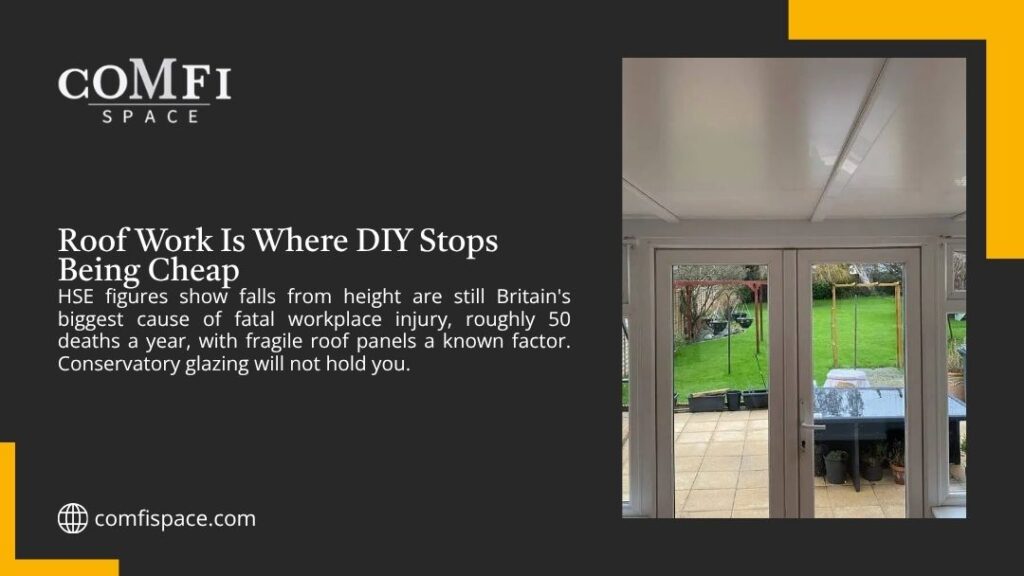
Why local homeowners choose ComfiSpace instead of DIY
ComfiSpace is not trying to sell five different home improvement products. The company focuses on one clear service: upgrading conservatory roofs so homeowners can use the space more often.
That matters because conservatory insulation is a problem-led purchase. People do not usually wake up wanting a technical roof product. They want the room to stop feeling like a freezer in January and a greenhouse in July. They want less waste, less hassle, and a solution that does not turn the house upside down.
ComfiSpace’s offer is local, simple, effective, and price-focused. The company serves homeowners across Sussex, Kent and Surrey, with a straightforward insulated panel upgrade designed for comfort without the drama of a full roof replacement in most cases.
ComfiSpace’s own message is simple: no full roof replacement in most cases, minimal disruption, and most installations completed in just one day. The brand also speaks to local homeowners across Sussex, Kent and Surrey, which fits the way people search when they want someone nearby rather than a faceless national chain.
A conservatory roof is not an online product you can judge from a basket price alone. A good visit helps the homeowner understand the roof, the finish, the likely disruption, and whether the system is right for that exact space. It also gives ComfiSpace a chance to offer clear advice and a fair, competitive quote before the homeowner commits.
The strongest part of the offer is its simplicity. A homeowner gets a conversation, a free no-obligation visit, a clear quote, and honest advice. If the system is suitable, the roof can usually be upgraded quickly, cleanly, and without the drawn-out disruption of a larger replacement project. If it is not the right fit, the homeowner should be told that too.
DIY content often makes the work sound easy. Sales content often makes DIY sound impossible. The truth sits somewhere in the middle. DIY can help in the right situation. But when the conservatory has become dead space, a fitted system is often the cleaner decision.
FAQs
What is the cheapest way to insulate a conservatory roof?
The cheapest options are usually thermal blinds, solar film, or a basic DIY conservatory roof insulation kit. They may help with glare and mild comfort issues, but they do not always solve winter cold, rain noise, leaks, or major temperature swings.
Are DIY insulated conservatory roof panels worth it?
DIY insulated conservatory roof panels can be worth it for a confident DIYer with a simple roof and accurate measurements. They are less suitable for older roofs, awkward shapes, hidden leaks, or homeowners who want a neat, professional finish.
Can I insulate the underside of my roof?
Yes, you can insulate the underside of a conservatory roof, but it must be done carefully. Moisture control, secure fixing, ventilation, weight, and finish all matter. If the roof already has damp or condensation, get advice before covering it.
Is insulation included with a modern roof installation?
Many modern conservatory roof upgrades include some form of insulation, but the exact build-up depends on the system, installer, and roof type. Always ask what materials are used, how the panels are fitted, and what finish you will see from inside the room.
A better way to fix a conservatory that is too hot, too cold, or unused
Can you insulate a conservatory roof yourself DIY? Yes, you can. For small problems, basic DIY may help. Blinds, film, or a light DIY conservatory roof insulation kit can reduce glare or make the room feel a little less harsh.
But if the conservatory is still too hot, too cold, noisy, draughty, or affected by condensation, the better question is whether DIY will go far enough. A quick fix may save money at first, but it can cost more if the finish disappoints or the problem comes back.
For homeowners in Sussex, Kent, Surrey, and nearby areas, ComfiSpace offers a simpler path: get the roof assessed, understand the options, and choose a fitted ComfiBoard roof upgrade if it suits the conservatory. The aim is not to make the job sound complicated. It is to stop the room from going to waste with the least possible hassle.
If your conservatory is ready for more than another temporary fix, speak to a local ComfiSpace expert and book a free, no-obligation quote.